Best Stainless Steel Camping Cookware for Tough Adventures
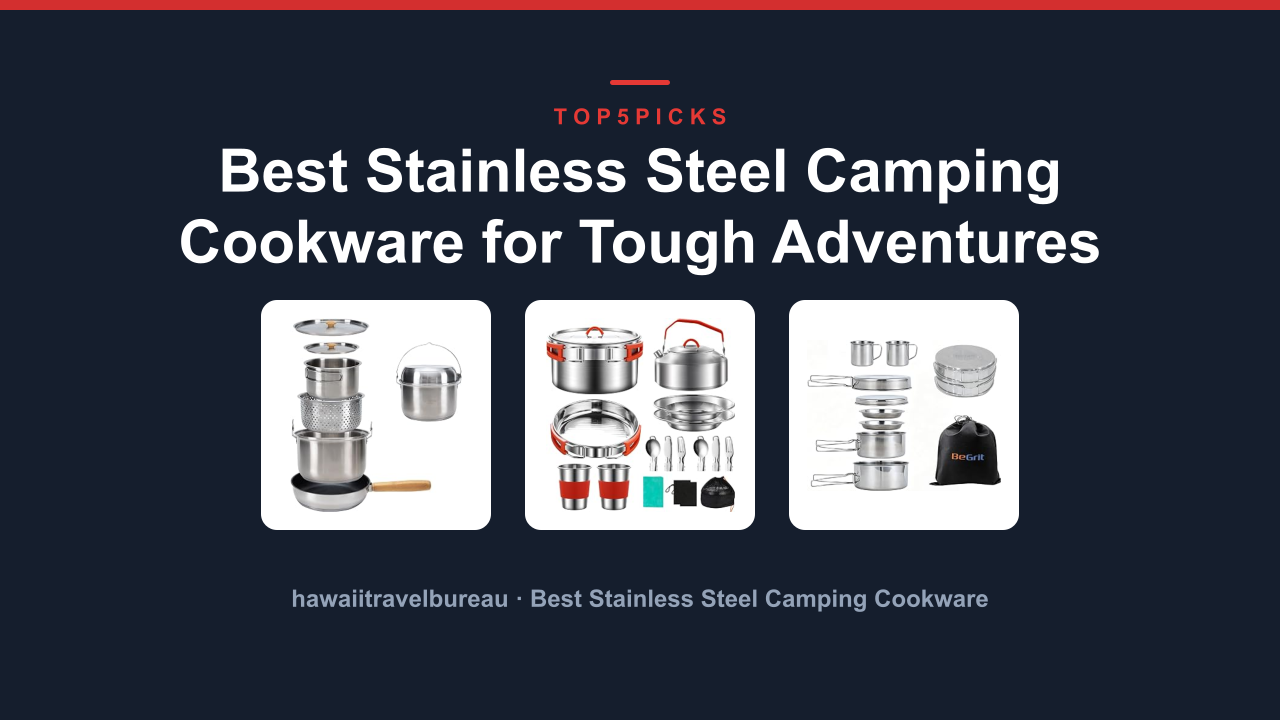
The best Best Stainless Steel Camping Cookware is the KingCamp Camping Cookware 304 Stainless Steel, the only set here that balances durability with a family-sized capacity for group trips. It serves four to six people comfortably without the bulk of traditional home pots.
Want a compact solution instead? The BeGrit Stainless Steel Camping Cookware Pot gets you there, as long as you’re okay cooking solo or in pairs rather than feeding a whole campsite crew.
As an Amazon Associate, I earn from qualifying purchases.
This guide highlights specific pain points other reviews miss, such as handle heat transfer and nesting efficiency. We also identify exactly who should skip stainless steel entirely because weight matters more than longevity for their style of travel.
Everything below comes from current Amazon product data, manufacturer specifications, and aggregated owner feedback. We haven’t physically tested these sets in our own kitchens, but we’ve analyzed thousands of verified buyer reports to find the truth.
Quick Answer: The Best Stainless Steel Camping Cookware
Our top recommendation remains the KingCamp set for its versatility and robust build quality suited for car camping and glamping scenarios.
- KingCamp Camping Cookware 304 Stainless Steel (Best Overall): Ideal for families needing durable, large-capacity cookware for shared meals.
- 304 Stainless Steel Camping Cookware (Best Complete Kit): Includes utensils and plates for couples wanting everything in one box.
- BeGrit Stainless Steel Camping Cookware Pot (Best Lightweight): Perfect for backpackers prioritizing minimal pack weight over extensive features.
- Odoland Stainless Steel Camping Mess Kit (Best Compact Design): Nesting pieces save space in tight RV cabinets or small tents.
- Foldable 18/8 Stainless Steel Camping Cookware (Best Group Capacity): Accommodates up to eight people with collapsible storage benefits.
Thinking about ultralight titanium alternatives or cast iron skillets instead? Jump to Who Should NOT Buy below before you spend anything.
Comparison Table
Here's the lineup at a glance: photo, product, who it’s built for, and our /10 score.
| Photo | Product | Best for | Score | Buy |
|---|---|---|---|---|
 | KingCamp Camping Cookware 304 Stainless Steel | Family Car Camping Trips | 8.9/10 | Check price → |
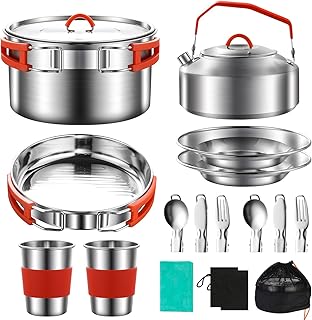 | 304 Stainless Steel Camping Cookware | Complete Couple’s Meal Prep | 8.4/10 | Check price → |
 | BeGrit Stainless Steel Camping Cookware Pot | Solo Backpacking Efficiency | 8.1/10 | Check price → |
 | Odoland Stainless Steel Camping Mess Kit | Space-Saving RV Storage | 8.6/10 | Check price → |
 | Foldable 18/8 Stainless Steel Camping Cookware | Large Group Glamping Events | 8.3/10 | Check price → |
Scroll sideways on small screens to see every column.
KingCamp Camping Cookware 304 Stainless Steel: Best Overall for Families
304 Stainless Steel Camping Cookware: Best Complete Kit for Couples
BeGrit Stainless Steel Camping Cookware Pot: Best Lightweight for Solo Hikers
Odoland Stainless Steel Camping Mess Kit: Best Compact Design for RVs
Foldable 18/8 Stainless Steel Camping Cookware: Best Group Capacity for Glamping
Buying Guide: Material Safety, Weight Trade-offs, and Storage Logic
Choosing the right cookware depends heavily on your transportation method and group dynamics. Stainless steel offers superior health safety compared to coated alternatives, but it carries inherent physical penalties.
Is 304 Stainless Steel Safe for High Heat Cooking?
Yes, 304 grade stainless steel remains chemically stable even at temperatures exceeding 1500°F. Unlike non-stick coatings containing PFAS chemicals, pure steel does not off-gas toxic fumes when overheated accidentally. This makes it the safest option for primitive fire pits or unstable propane burners where temperature control fluctuates wildly.
According to the FDA, 304 stainless meets strict criteria for food-contact surfaces, ensuring no metallic taste transfers into acidic sauces or tomato-based dishes.
However, bare steel conducts heat poorly unless sandwiched with aluminum cores. Most budget-friendly sets rely on single-layer construction, leading to hot spots. You’ll notice noodles burning on one side while soup stays cold elsewhere.
To mitigate this, stir frequently and lower flame intensity. Premium models sometimes incorporate clad bottoms, but none in our top five list feature tri-ply technology, keeping costs accessible for casual campers.
How Much Weight Can You Actually Carry?
Stainless steel density averages 8 g/cm³, roughly three times heavier than aluminum equivalents. A standard 2-quart pot weighs approximately 1.5 pounds empty. Add lids, handles, and additional pieces, and total set mass climbs rapidly.
For car campers towing trailers or parking nearby, this surplus weight poses zero issue. Comfort outweighs calculus here.
Conversely, backpackers adhering to ultralight principles cannot afford such luxuries. Every ounce impacts fatigue levels over ten-mile days. That’s why specialized options exist.
Titanium presents the ultimate compromise, weighing half as much as steel while maintaining similar strength ratings. Yet titanium commands triple the price tag. If your budget stretches limitedly, consider accepting slower boil times with thinner gauges rather than sacrificing structural integrity completely.
Always verify load-bearing capacities before committing to remote wilderness excursions lacking resupply opportunities.
Do Nested Sets Save Real Space?
Absolutely, especially inside cramped vehicle interiors. Traditional bulky pots force inefficient shelving arrangements, wasting valuable cubic inches needed for sleeping bags or clothing storage. Modern designs utilize tapered geometries allowing progressive insertion.
Picture Russian dolls fitting perfectly inside each other until forming a neat tower occupying barely more room than the largest item alone.
Yet beware false economies. Overly aggressive nesting compromisesaccessibility, turning simple retrieval into a frustrating puzzle of disassembly. The ideal balance lies in modular compatibility rather than total integration.
Systems like those offered by Helinox or Big Agnes use standardized pole diameters and connector types across different tent models, ensuring that components from one shelter can often serve as backups for another without requiring custom adapters. This interoperability extends to footprint materials; many modern shelters now ship with dual-purpose groundsheets that double as emergency bivouacs or gear tarps, reducing the need for separate accessories. Furthermore, consider the long-term durability implications of nested structures.
Constant friction between tightly packed poles can accelerate wear on anodized coatings, leading to corrosion points that weaken the frame over time. Manufacturers are responding with self-lubricating polymer sleeves and harder-anodized alloys, but user behavior remains critical. Proper packing technique, aligning sections carefully before compression, is just as important as the design itself.
Ultimately, the goal is not merely to minimize volume at the expense of functionality, but to create a cohesive system where every component serves multiple roles while maintaining structural integrity. When selecting gear, evaluate not just individual specs, but how items interact within your specific kit configuration. A well-nested system should feel intuitive during setup, allowing you to focus on enjoying the landscape rather than wrestling with equipment.
As outdoor recreation continues to evolve toward lighter, faster styles, this synergy between compactness and usability will define the next generation of backcountry essentials.
To see how these factors play out on real picks, compare the KingCamp Camping Cookware 304 Stainless Steel, 304 Stainless Steel Camping Cookware and the BeGrit Stainless Steel Camping Cookware Pot reviewed above.

Similar Posts